The First 30 Days
What if business school students developed the habit to look across disciplines from the first class?
The problem
Business schools take great care to design comprehensive and current curricula. Yet students often experience them as separate subjects: strategy, finance, operations, marketing, etc. Each is taught well but encountered largely in isolation.
Integration tends to happen later, through capstone projects, consulting assignments or multidisciplinary challenges. By then, students may already have become accustomed to thinking about the subjects separately.
The idea
A new chief executive's first 100 days are often seen as a defining period. Those early weeks shape how they come to understand the organisation, its relationships, its place within the wider business ecosystem, and ultimately influence the decisions they make.
The First 30 Days borrows that principle for business education.
Rather than adding another subject, it overlays the existing curriculum with a short daily reflection that helps students notice relationships and dependencies as they naturally emerge through lectures and case studies.ions.
The hypothesis
If students develop the habit of looking for relationships, influence and consequences during their first month, they will start to connect parts of the curriculum as they continue with their course and experience their studies in a more integrated way.
What they will keep from this activity is a set of questions they will ask when they encounter something new, be it a new class, a new technology, or a new competitor: Where does this fit, and what does it connect to?
The programme at a glance
What it is: A four-week overlay on the first month of teaching, designed to help new students look for connections among topics and ideas they encounter in business school.
What it is not: A new module, a systems-thinking course, or a replacement for existing orientation.
Curriculum changes required: None. Students draw on the lectures, cases and conversations that are already taking place. Weekly conversation sessions can take place as part of existing tutorial or orientation slots.
Student commitment: Around fifteen minutes per day on four days a week, plus one weekly facilitated conversation session of 45 to 60 minutes. This activity is intentionally ungraded, to avoid students working to the grading criteria.
Who facilitates it: A personal tutor, academic advisor, teaching fellow or programme lead, working with a group they already meet. No systems-thinking background is required.
Staff commitment: Around 30-45 minutes to read the pack, then four conversations of 45 to 60 minutes, and a short preparation for each weekly session.
What students produce: A developing map of the coffee shop, a redrawn map after Week 4, and a postcard to their future working self, capturing the questions they want to remember. Activities are carried out using a pen and notebook.
What it produces for the programme: Each student's Week 1 map and their Week 4 map, four weeks apart, show the same person moving from a simple list of business parts to an interconnected ecosystem map tracking tension, trade-offs, and consequences.
Comparing the early and final maps provides one visible indication of how students' representations of the business changed over the month.
The final reflection showcases the questions they now choose to ask.
The design
The First 30 Days draws on Jerome Bruner’s idea of the spiral curriculum and the logic of BJ Fogg’s Tiny Habits: begin with a behaviour small enough to repeat easily, then build complexity without changing the basic action.
The repetition is deliberate. The aim is to create a small daily habit that gradually changes how students experience everything else they're learning.
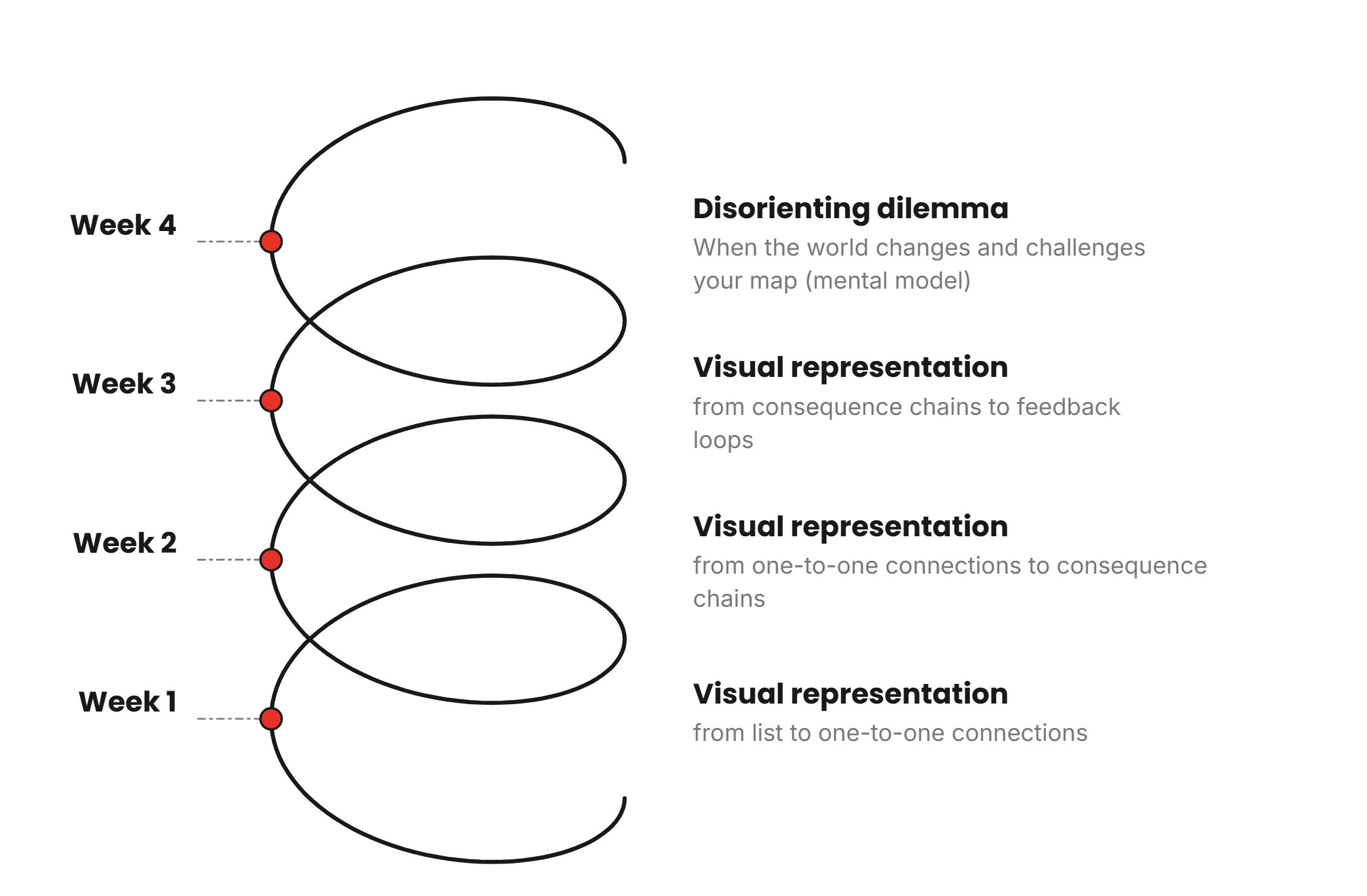
The design of the First 30 Days programme
The programme involves a daily reflection exercise and a weekly facilitated conversation. It centres on a local coffee shop, with students drawing on their lectures, cases and conversations as the month progresses and adding whatever they find relevant to the case.
Week 1: Look Across the Counter. What connects to what?
Students look at an everyday local coffee shop and map the connections between the things they can see from the counter and the things they cannot.
Week 2: The Teeter-Totter. What has to give?
The owner is losing money and considers ways to fix it. Students trace the consequences of each solution, discovering that every fix has multiple consequences.
Week 3: What Goes Around Comes Around.
What comes back round? Students follow one of the fixes explored in week 2 until it arrives back where it started. They find two kinds of circle: ones that feed themselves and grow, and ones that push back and settle.
Week 4: What happens when the world changes?
A large chain coffee shop opens directly opposite, with more seating and free Wi-Fi. Students find out what their map was built on and redraw it.
In the final conversation, students are given a new fact that destabilises the map they have been building. They think about the consequences of changes in the business’ external environment.
The conversation at the end of each week uncovers the students' different perspectives. Because every student works from the same starting material, any difference between two maps is a difference in how each of them decided things fit together. The key lessons here are:
A business problem can have more than one defensible solution, and every solution can create consequences elsewhere.
Differences in perspective can be leveraged to create a richer understanding of the bigger picture.
How to run this
Who runs it
Depending on how the course is set up, this could be run by a personal tutor, an academic advisor, a teaching fellow, or a programme lead. The group size that works is roughly eight to twenty. No experience in systems thinking is required.
How it runs
Daily prompts are sent to students by email each morning, four mornings a week.
Students can work through each prompt in their own time on the day they receive it. Ideally, they should book a recurring 15-minute slot in their calendars to help them build the habit. If a student misses a day, they pick up with the prompt the following day and continue.
The prompts are provided in the facilitator pack, which can be downloaded below.
When it runs
It is recommended to start this programme in the first or second week of teaching, when students are still new to the programme but have class material to draw from. The aim is to create a small daily habit of noticing relationships and patterns in everything they are learning.
Interested in piloting The First 30 Days?
If you’re a programme director, tutor or faculty member interested in piloting it with an incoming cohort, I’d like to hear from you.
You can download the facilitator pack below and use it independently. It contains the four weeks of student prompts, weekly conversations and everything you need to run it.
If you run this, I would be interested to learn from your pilot: what happened, what students engaged with, where they struggled, what changed in their maps and what you would change. I would equally be open to a short conversation to help you tailor it for your specific institution, or discuss anything you are unsure of.